
Update as of 5 March 2026

21 February – Recharging batteries at Camp 3

At camp 3, 21 February is a day of rest. Between a minor virus that has been going around and has severely affected Anthony and then Carlos, a few injuries that are slow to heal for some, and the many logistical tasks to manage, the team decides to take it easy. The sun is shining, making this recovery period particularly pleasant, even if the prolonged dry weather makes them want to set off again to explore.

Sophie takes advantage of this day to assemble the table saw and cut in half the stalagmites recovered from the Kosisilita cave, taken from and within the loose deposits. Yann, Luc-Henri and Patrick, from the film crew, immortalise the operation while Monika helps sand down the different halves of the stalagmites. At camp, science is progressing steadily.

Sophie cuts the stalagmites from Kosisilita in half.
Monika polishes the stalagmite conscientiously.

At camp 2, the relief team settles into Camp Big-Bag. Michel, Julien, Katia, Denis and Bernard arrive during the day, accompanied by two Papuans who have come to help them carry their gear. The rest of the day is spent making the camp more comfortable: building bamboo chairs, setting up sleeping areas and organising the space.

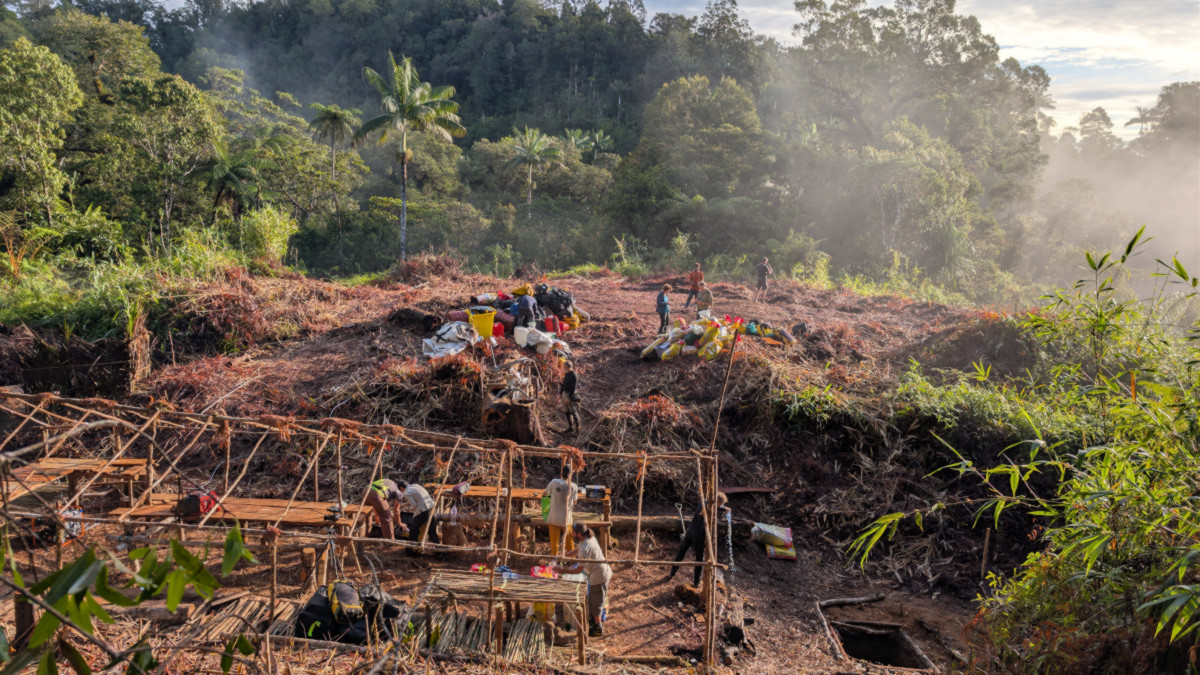
Camp 2, the advanced Big Bag camp and the underground complex Valngau-Ralapusa seen from the sky
Breakfast at the Big Bag camp

22 February – From hope to disappointment

Early in the morning, the team is ready for a great first descent in the lower part of Ralapusa. Julien, motivated as ever, takes the cameras to film what seems to be a promising moment. Less than two hours later, it's a cold shower. A violent flood has swept through. On 17 February, it rained cats and dogs, filling all the basins and pools in the cave to their overflow thresholds. From the very first few metres of progress, the water is murky and uninviting. After several hours spent modifying their equipment to avoid swimming as much as possible, which seemed inevitable, the team had to face the facts: reaching the point of the last exploration was impossible today. Worse still for morale, the numerous signs observed along the way bore witness to the frightening extent of the flood. The evidence left on the walls speaks for itself; in places, it is more than two metres above the threshold of the pools. Unable to continue the exploration, the team focused on taking images and photographs before returning to the surface.

Images from the shoot with the leading team in Ralapusa

Meanwhile, at camp 3, the absence of heavy rainfall for two days encourages some to return to the flooded part of the Gauunu chasm. Sophie wants to collect a stalagmite to study the paleoclimate. Yann Rineau, for his part, does not want to miss out on any of these scientific operations. A team consisting of Sophie, Yann R., Monika and Franck therefore set off for the cave after breakfast.

Franck begins mapping the cave while Sophie, assisted by Monika, collects samples from the stalagmites, under the watchful eye of the camera. Continuing with the mapping, Franck reaches the critical point: only a small puddle remains in the siphon... behind it, the gallery continues. At first, the ceiling is low, requiring progress on all fours, but soon it gets higher. About 200 metres after the flooded area, Franck discovers a superb, heavily concreted meander leading to the top of a nine-metre shaft. Further down, the sound of water can be clearly heard. The Gauunu chasm continues and looks promising.

Wet vault of the siphon section after the flood

Sophie brings up three samples: a core sample drilled from a stalagmite flow, a small stalagmite and a larger, candle-shaped stalagmite found by Franck lying in a small upstream area at the base of the shaft. The first two samples should make it possible to date a period prior to the filling that once covered the shaft, traces of which can still be seen on the walls. The ‘candle' stalagmite could provide a final age for this episode. The results will be available in a few weeks, once the uranium-thorium dating has been completed.

Stalagmite cierge or ‘candle' stalagmite

Insert: Speleothems

The word 'speleothems' is a term used by scientists to refer to all underground concretions: stalagmites, stalactites, draperies, etc. Stalagmites in particular are used to extract ancient climate data thanks to their internal structure of successive layers, chronologically framed by the ancient base and the more recent top. They represent a true book containing past climate information, recorded page by page, or layer by layer. Changes in magnesium, strontium, oxygen, carbon, but also in crystallisation, stalagmite diameter or pollen are all pieces of information which, once translated, give us indications of changes in humidity, temperature and vegetation. Uranium-thorium dating allows each of these layers to be dated accurately, going back as far as 600,000 years.

The saw that allows cutting the stalagmites in half.

Back at the Kosisilita cave, Tudor, Anthony and Yann A. return to finish mapping the galleries discovered on 20 February and continue exploring beyond the terminus, marked by a vast deep water basin. They have to swim about 80 metres before temporarily regaining their footing. But a little further on, the ceiling plunges definitively into the water: this is the siphon. The disappointment is palpable. It is not the great chasm they had hoped for. However, the team did not give up and meticulously explored the small tributaries, completed the topography and took numerous images. In the end, the Kosisilita cave extends for just over a kilometre and is 48 metres deep.

Yann A. at the topography
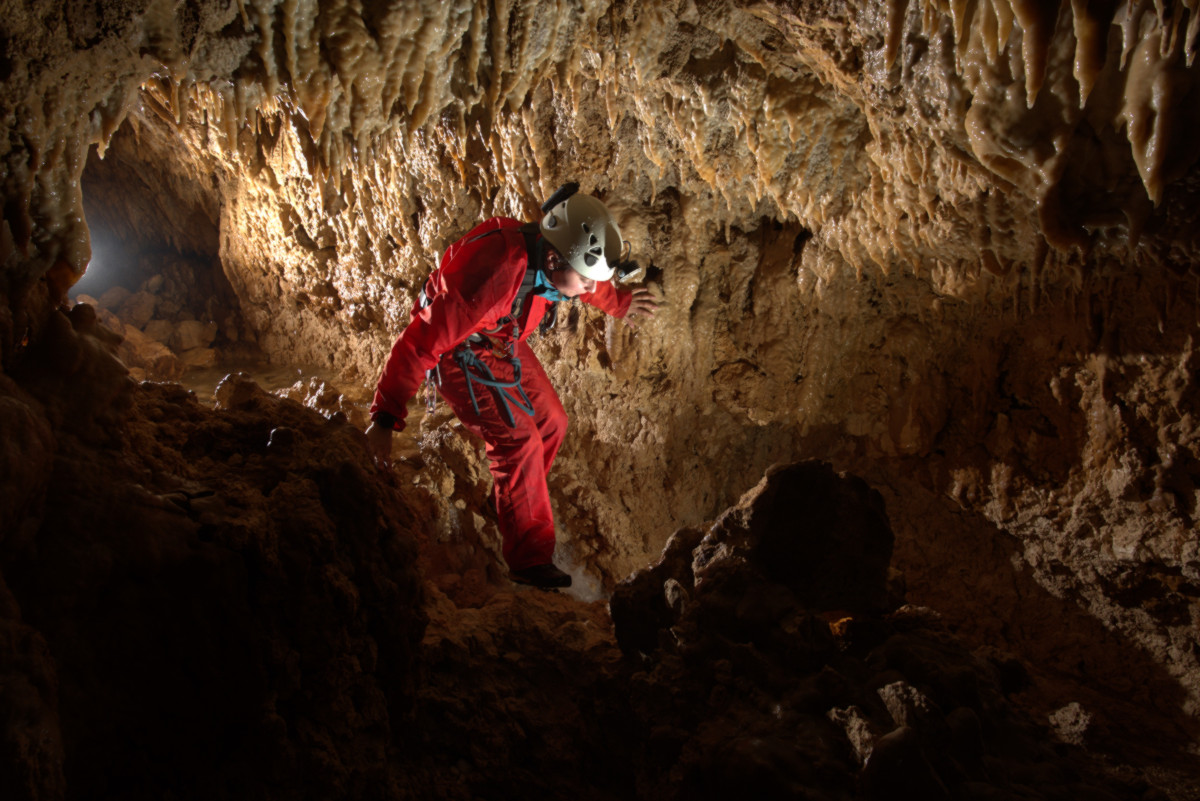
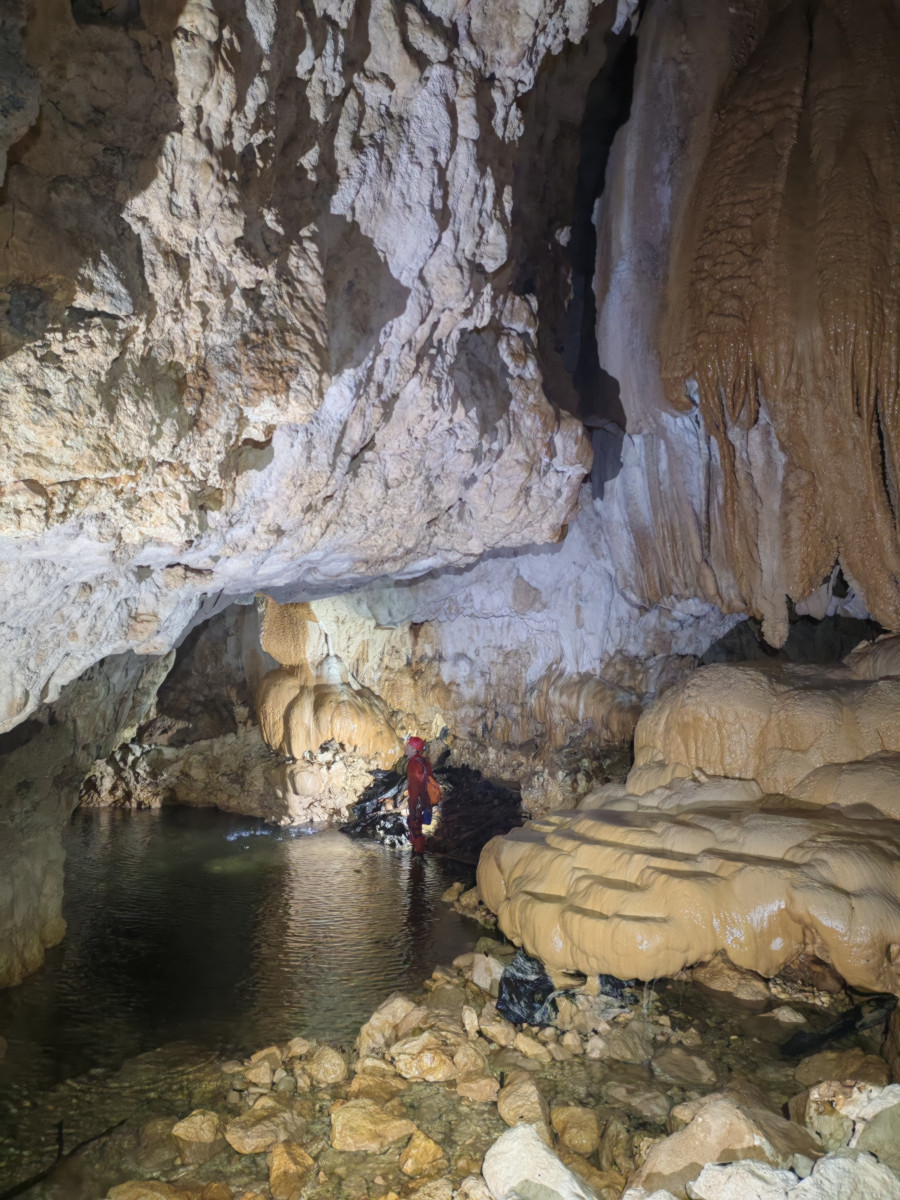
Kosisilita offers a beautiful gallery with very photogenic white limestone.

23 February – The Gauunu chasm, between promise and threat

At camp 3, now that the exploration of Kosisilita is complete, new objectives must be found. A drone survey carried out by Luc-Henri 1.5 km north of the camp identified a dark spot in the forest: a backwater or the entrance to a promising sinkhole? Carlos, the two Yanns, Thomas and Anthony set off on reconnaissance, machetes in hand. Rain eventually set in, making progress difficult. After several hours of clearing a path through the vegetation, they finally reached their destination... which turned out to be nothing more than a bog.

The vegetation of the Nakanaï makes the journey difficult.

The further the team advances in this area, the more it realises that the thalwegs encountered do not lead to obvious drainage points. Water seeps into the karst in a diffuse manner and, in the event of heavy rainfall, when the soil is saturated, it flows slowly towards the slopes of the Galuwé. In addition, clay deposits are particularly abundant in this area, which is not conducive to the formation of penetrable cavities.

Fortunately, the Gauunu chasm may still hold some surprises. Natalia and Franck set off early in the morning. Upon reaching the top of the nine-metre shaft, the end point of previous explorations, Natalia attaches the rope and continues with the rigging. After a few ledges, a large void opens up beneath their feet. The deafening sound of a waterfall echoes. While Franck carries out the topography, Natalia rigs a 31-metre shaft, fed halfway up by a powerful spring gushing from a crack. At its base, the river rushes into a spectacular meander over fifteen metres high, carved into magnificent white limestone. The two explorers progress from ledge to ledge, installing flood-proof lines on the ledges. Eventually, they have to stop because they run out of rope. However, the river continues, vast and promising, probably towards the Lalu resurgence.

Natalia rigs the P31

But as they prepare to leave, the situation changes dramatically. At the low point that drained when the chasm was discovered, Natalia notices that the water level is rising rapidly. There is no time for contemplation: they must get out, and fast. There are fifty metres left to the base of the entrance shaft, but the water is almost reaching the ceiling in some places. They finally arrive at a siphon. They know that it is only two metres long and that beyond it, the exit is guaranteed. Without hesitation, they cross it while holding their breath. The critical situation is narrowly avoided.

The outcome is mixed: Gauunu is promising, but access to it is protected by a low-lying area that is likely to become a siphon during rainy periods. Without reliable weather forecasts, its exploration remains uncertain.

Franck uses the opportunity to collect samples of the underground fauna.

24 February – Recovery and reflection

Today, no teams are heading out into the field, either from camp 3 or camp 2. The day is devoted to recovery, processing scientific and topographical data, and everyday tasks such as laundry.

Topographical data always raises high expectations.
Laundry
Laundry

At camp 3, the team also takes advantage of this break to observe the hydrological behaviour of the Gauunu chasm in order to better assess the feasibility of continuing exploration there. Natalia and Franck return to the entrance of the chasm in the morning and find that the siphoning passage is once again accessible. This is good news: the water level seems to be dropping relatively quickly. It is also an opportunity for Natalia to retrieve her phone, which she lost in the rush during the eventful outing the day before.

The morning is also spent working on the stalagmites collected at Gauunu. They are sawn in half lengthwise, polished and prepared for analysis. The large 44 cm stalagmite is no exception. As always, the film crew captures these scientific procedures on camera.

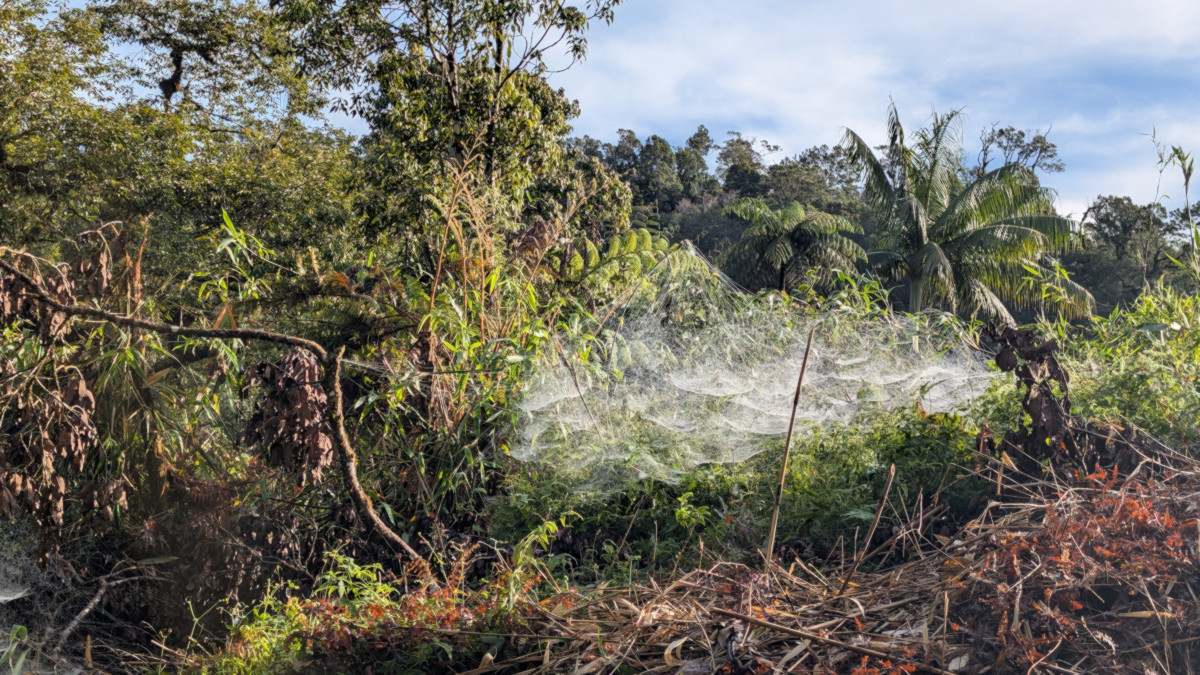
Mist hangs over the forest.

At around 1:30 p.m., a heavy downpour hit the area and lasted for nearly two hours. At the end of the afternoon, Yann A. and Franck returned to observe the entrance to the chasm. They discovered that a veritable torrent was now rushing into the first shaft. The situation becomes complex: continuing the exploration safely now seems uncertain.

At the entrance to the chasm, a powerful torrent rushes in.

25 February – Camp 3, between weariness and hope

If the team wishes to continue exploring Gauunu — its only caving objective in the area now — it must first ensure that the risks remain within acceptable limits. Franck and Natalia therefore set off to explore the forest above the chasm to see if there is a passage that could bypass the flooded area. But their search proves fruitless: the water stagnates on the surface and there are no visible absorption points.

For their part, Yann A. and Anthony attempt to climb up from the base of the entrance shaft. An ascending passage is visible from the bottom. After placing several anchors, they manage to reach the passage... which quickly closes up. Once again, there is no continuation.

If exploration is to continue, there must be a plan in place to wait underground in the event of flooding. The team therefore decides to prepare a survival kit including a stove, food, equipment to create a hot spot and a communication system. The expedition has two Pimprenelle devices for this purpose, ground transmission devices that use long waves to communicate through rock. But these devices are currently at camp 2. A transfer mission is therefore organised. Thomas and Francis, the locals, leave camp 3 while Nolan and Augustin make the reverse journey from camp 2. Carlos and Monika accompany them for part of the way.

The camp 3
The camp 3

26–27 February – Ralapusa, camp 2

After spending two days waiting at camp 2, activity resumes. Jessica, Tom, Bogdan, Sergio and Laurent return to camp Big-Bag. At dawn the next day, two teams split up. Sergio and Laurent head upstream towards Ralapusa. Their goal: to reach a higher level visible in the rock face, which may lead to a semi-dry gallery that is still unknown.

Laurent and Sergio explore and photograph the upstream area of Ralapusa.

The other team, Jessica, Tom and Bogdan, set off downstream from Ralapusa. They make rapid progress to the terminus reached a week earlier by the previous team. The ‘first' begins at a depth of -145 m. Several large pools must be crossed. Then the team discovers a huge giant's pot completely drained of water. Fortunately for them, because when it is full, the small space between the spillway and the ceiling must turn this place into a temporary siphon. A rope is set up to cross the obstacle, named the ‘Banana Shaft'.

Beyond that, the cave becomes spectacular. There are two shafts: the first is about fifteen metres deep, followed by a second one about 22 metres deep. The cave becomes much larger and a suction current can be felt in the narrower areas. It is vast, magnificent... and it goes on and on. Unfortunately, the team has to stop due to a lack of gear. A caver's dream: to stop at a cave that continues...

By 9 p.m., everyone is back at camp. The upstream team did not manage to reach the upper gallery, but not to worry: sooner or later, another team will return.

Every gallery in Ralapusa offers beautiful moments of first-time exploration.

26 February – Camp 3, searching for new objectives

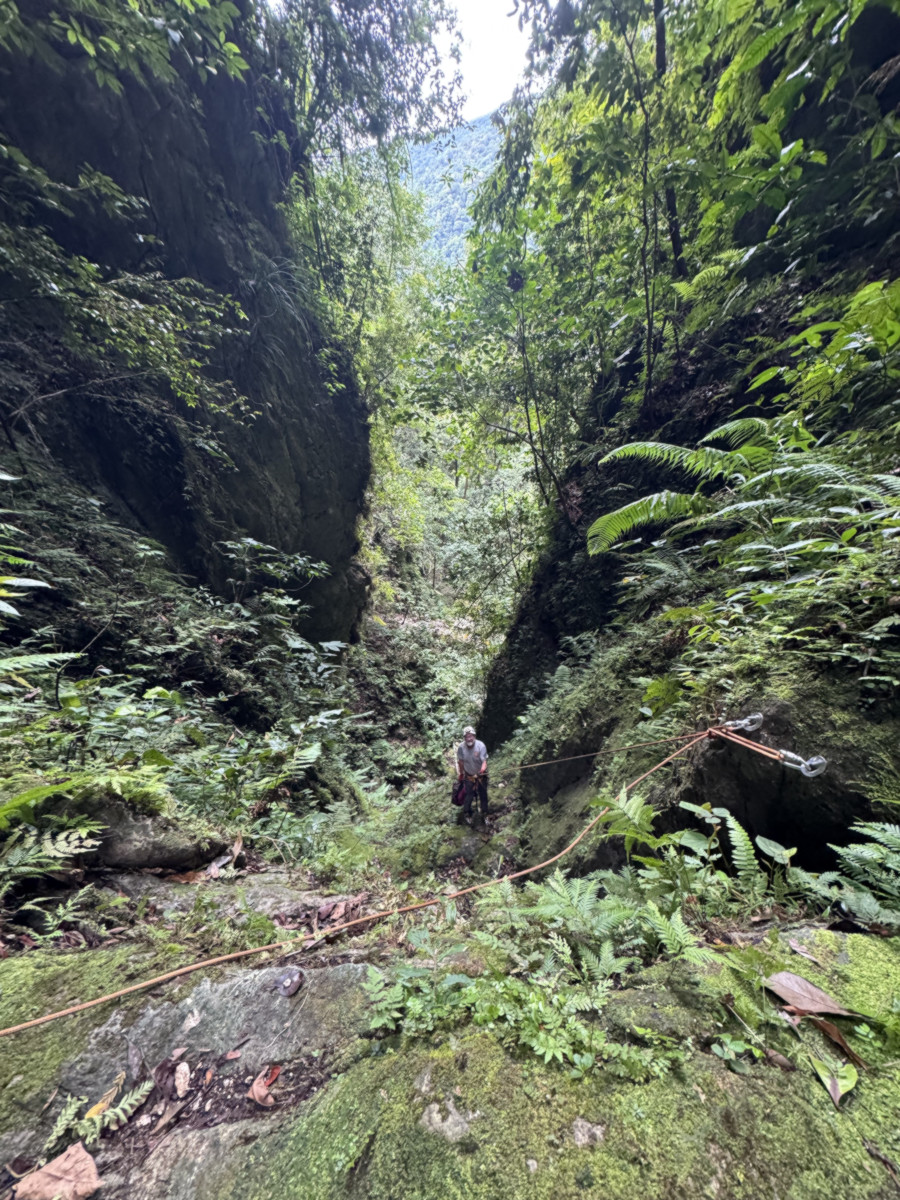
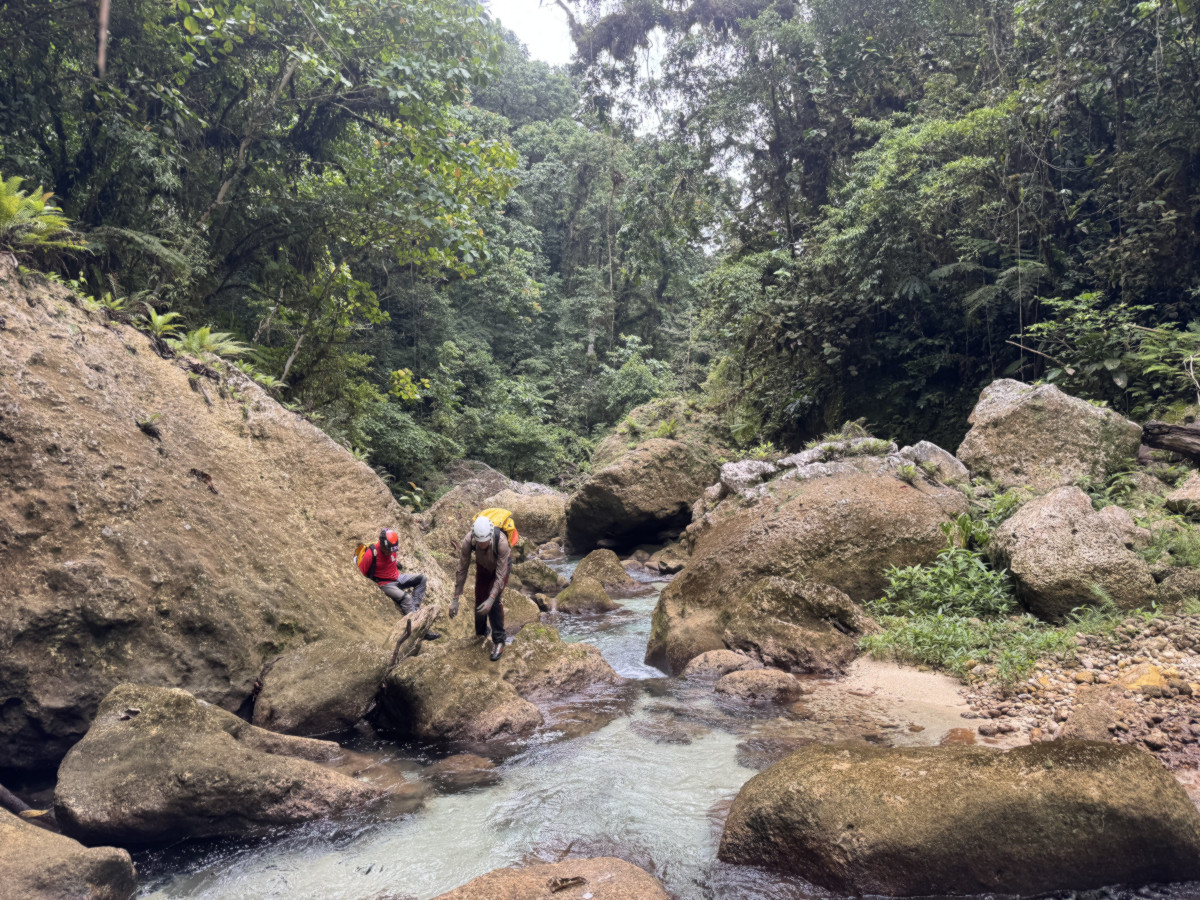
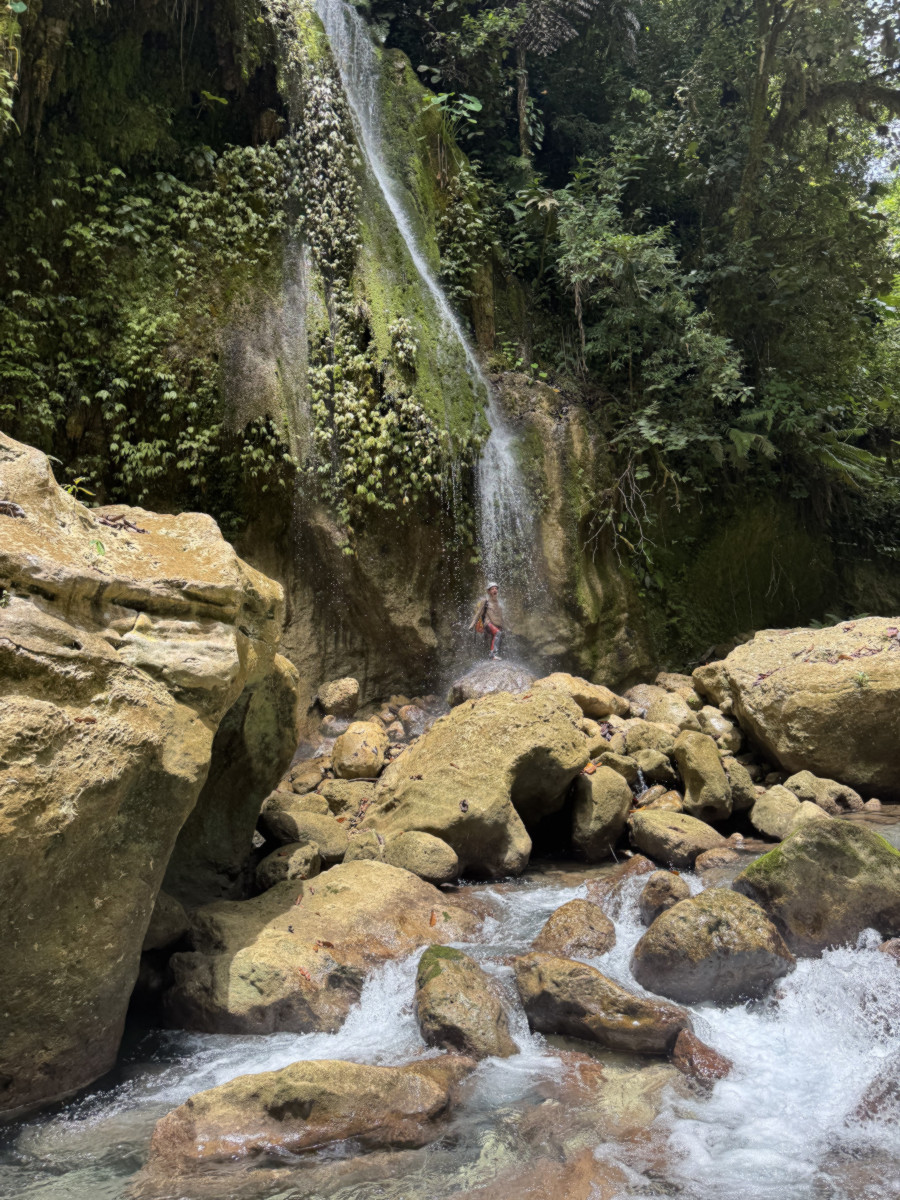
Camp 3 cannot rely solely on the Gauunu chasm, whose exploration remains uncertain to this day. They therefore want to reach an area further north which, according to maps and satellite photos, could conceal a beautiful sinkhole. Anthony, Tudor, Yann A., Nolan and Franck set off early in the morning into the forest to carve out a new route towards this goal. Ridges and valleys follow on, and after several hours of battling through the vegetation, they reach a lovely river. After a welcome lunch break, they follow the river upstream until a series of waterfalls slows their progress. Their target is still beyond. Setting off on the left bank, at around 3 p.m. they reach a point still 500 metres away from their target as the crow flies, making it impossible to reach it that day. They'll have to come back another time, and then they might even try to descend this beautiful canyon!

The waterfalls slow down the team's progress, but allow them to enjoy a relaxing moment.

For now, they turn back and follow the river further downstream, allowing them to move more quickly. This river, lined with small cliffs dotted with concretions, appears to be an ancient cavity. But the thick clay deposits they observe throughout this area mean that, once again, the river eventually disappears into the sediment. The area is definitely not conducive to the formation of deep cavities. The return journey will take place at nightfall, after more than 10 hours of scrambling and 15 kilometres of walking. Upon arrival at camp, the team will not escape interviews conducted by the film crew.

27 February – finally time for action at the Gauunu chasm

Rainfall, still daily, has lost its intensity. The critical passage is no longer filled with water and the water level is falling relatively quickly: if there is no rain today, a team will leave at the end of the day, as there is almost never any rainfall at night or in the morning. In the afternoon, a team consisting of Monika, Sophie, Carlos, Yann R. and Patrick set off for the Gauunu chasm to set up and test the Pimprenelles. On the way back up, additional images are taken to supplement those already existing. Everything is working perfectly.

The team consisting of Sophie, Monika, Yann R and Mowgli sets up the Primprinelle system.

After preparations and rest, Natalia, Yann A., Anthony, and Franck set off just before nightfall to continue their explorations. The terminus of February 23 is quickly reached. Natalia and Yann start setting up the equipment while Anthony and Franck head upstream to explore the gallery at the base of P31. Unfortunately, it pinches after only a few meters of progress. They therefore join the leading team while doing the survey. The river is magnificent and continues its course in a meander that gradually loses elevation. A bit of elevation is gained thanks to a few ledges. The entire team finds themselves at the base of a final shaft dug along a fault. Another disappointment: a few meters beyond, there's the syphon. This one, murky and bordered by flood foam, is surely temporary, but to venture beyond, even with favourable conditions, after the syphoning zone at the entrance, would be reckless: they will not continue the exploration.

After P31, everything points to a wonderful exploration.
Franck and Anthony pose in the meanders and Yann A captures the moment.

Before derigging everything, they head to explore a gallery that opens at the top of the fault. Unfortunately, it leads to an upstream that narrows and does not allow them to bypass the syphon. They climb then by taking a fossil gallery that develops parallel to the active one. In the end, the chasm reaches 960 meters in length with a little over 150 meters of elevation difference: they are far from the great chasms they had hoped for and the resurgence of Lalu, but that's how it is!

Yann A injects fluorescein into the final siphon.
In the fossil gallery, fossils and traces left by water can be seen.

February 28 – End of exploration at Gauunu

At the camp 3, the day is dedicated to recovery and finalising the topography. The exploration of the Gauunu chasm is coming to an end. The maps and satellite images are being studied again in search of new targets. Under the common tent, Sophie is also organising the collection of samples for dating the large "candle" stalagmite of Gauunu, under the watchful eyes of the cameras.

At the camp 2, activities have resumed. Bernard, Denis, Michel, Katia, and Julien are getting ready to head back to the Big-Bag camp. A new rotation is being organised, and with it the prospect of a final exploration in Ralapusa downstream.

March 1st – Ralapusa, a memorable day of exploration

At dawn, at the Big-Bag camp, the entire team is ready. At 8:30 am, they leave for Ralapusa downstream and enter the underground section around 10 AM. The cave is demanding. Crossing the numerous pools out of water requires a series of manoeuvres on fixed rope, which slows down progress. Loaded with exploration gear, they finally reach the top of the last shaft equipped by the previous team around 12:30 pm.

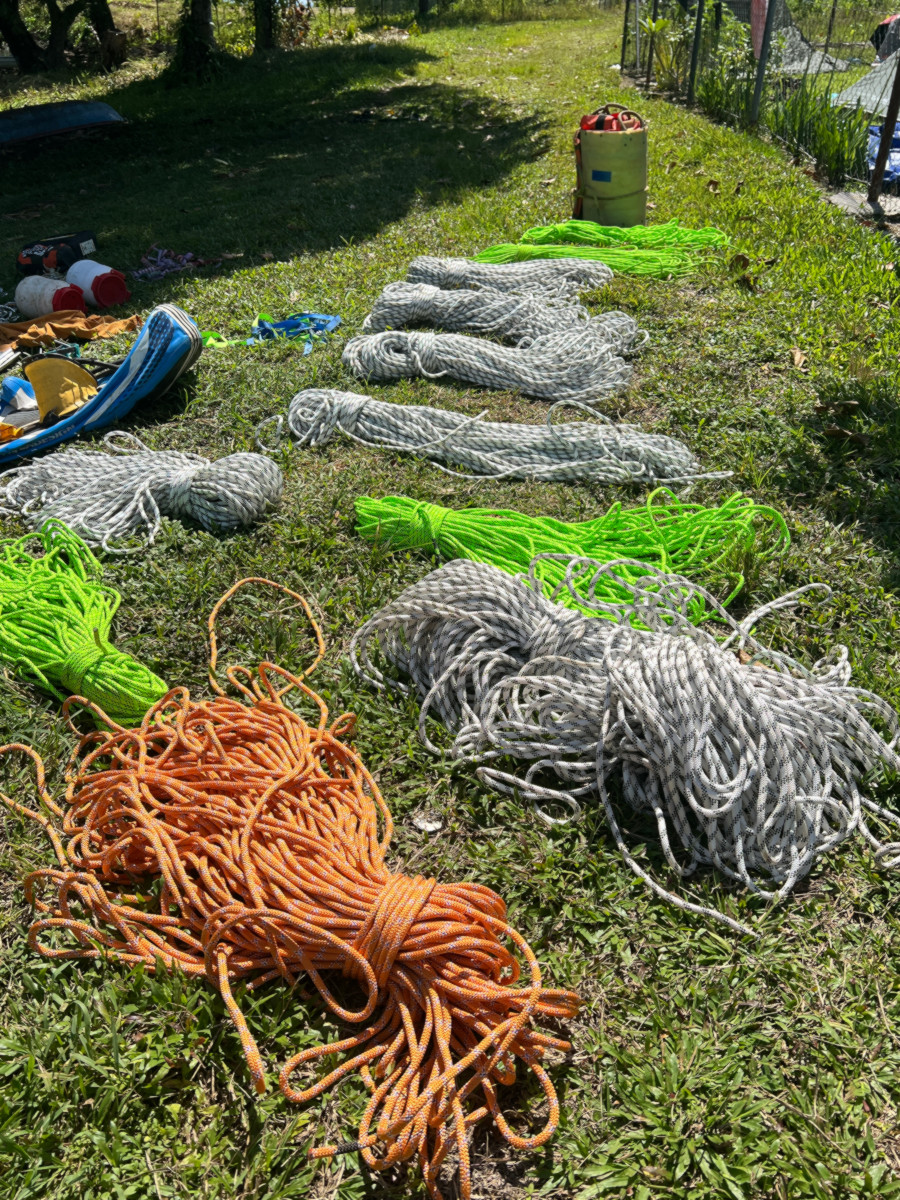
Katia takes charge of several re-rigging to preserve the ropes provided to the expedition by the company Courant. Safety remains the top priority in this challenging environment.

Katia derigs to preserve the ropes provided by our partner Courant.

The team divides the roles in order to continue the exploration: Michel and Denis carry out the survey while Katia, Julien, and Bernard pave the way. The obstacles follow one another in a spectacular setting: small verticals, water flows, semi-flooded areas cluttered with trunks. In a low section of about a hundred meters, an astonishing marker is discovered: a topo tape, placed near the entrance of the cavity at the beginning of the expedition, is found wedged near the ceiling. The flood of February 17th completely filled this gallery.

Climbing up the vast shafts

Further on, a shaft about twenty meters deep is rigged. Beyond, on a ledge rigged by Bernard, now leading the way, another impressive void appears: a 40-meter-deep shaft. The team is enthusiastic. The volumes are becoming very large. The Bersub headlights are required to pierce the darkness with their powerful beam: a new large shaft of 25 meters appears; its vaulted ceiling must measure 35 meters in diameter. At its base, a large gallery seems to continue. Unfortunately, the team has no more rope. To prepare for the next steps, four anchors are derigged, along with a hygrometer and a temperature sensor.

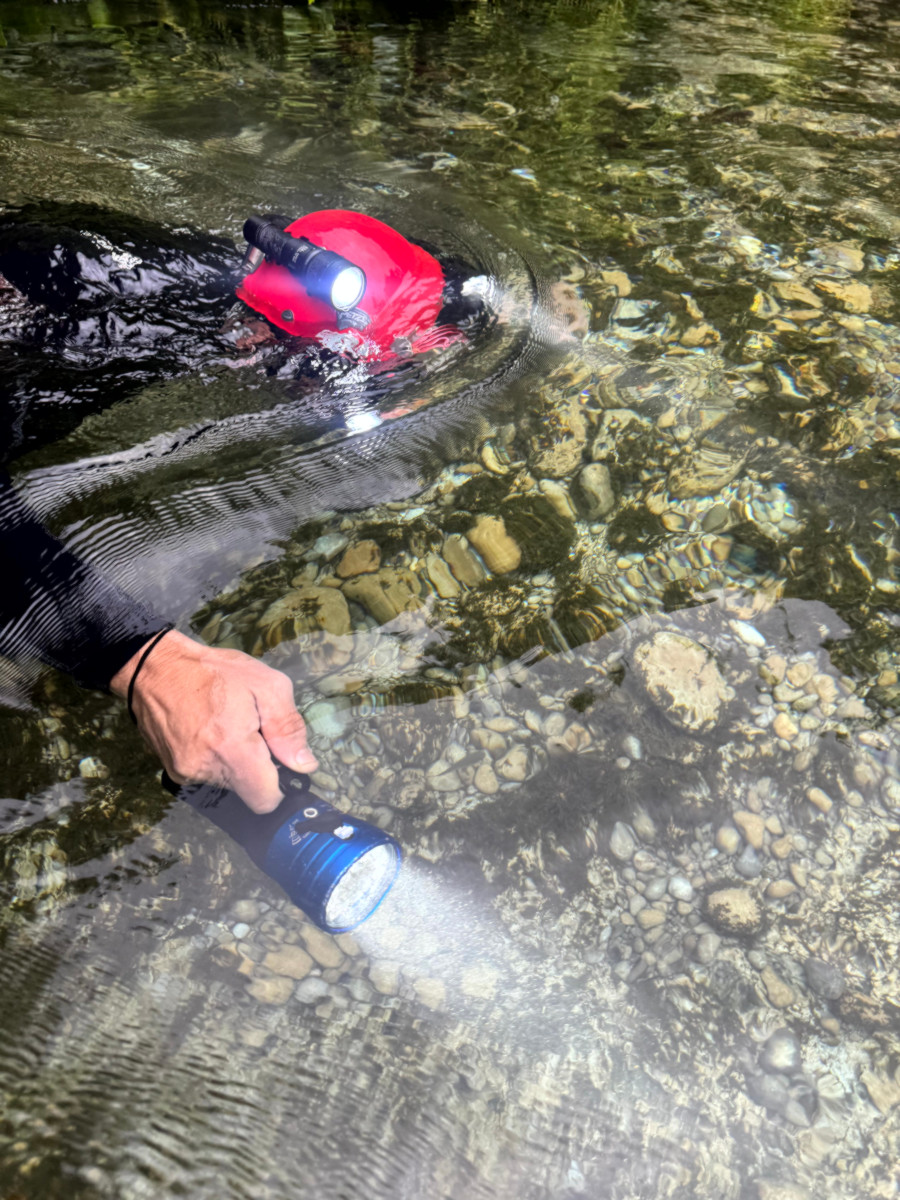
The Bersub headlights are required to pierce the darkness with their powerful beam

Meanwhile, Katia explores an upper gallery. An exceptional setting reveals itself to the astonished eyes of the team: draperies, immaculate concretions, clay trees, formations resembling "sunny-side-up eggs." It's the icing on the cake. But it is already 9 PM, the team must retreat. After an endless ascent, they reach the camp at 5 a.m., after spending 18 hours underground. The complete system, Valngau-Ralapusa, consisting of the megadolina with its upstream and downstream networks, totals 1,760 meters of galleries, with a measured depth of 278 meters, with a view at -300 meters at the bottom of the 25-meter terminal shaft.

'sunny-side-up eggs.'

At camp 3, the team despairs. On this side of the plateau, the bottoms of thalwegs are cluttered with clay, the rock is only rarely visible and the slight slopes all lead to the colossal void of the Galuwé canyon. A path is carved towards the west but does not give the expected results.

‘Go west,' the instruction.

A final visit to the Kosisilita cave allows Yann R. to collect a sequence of images in progress underground for the film.

Franck collects underground fauna in front of Yann R.'s camera and Monika poses in front of the camera.

March 2nd - Preparing for the continuation.

At the Big-Bag camp, the day is devoted to taking a break after the long exploration of the previous day.

An important project is being worked on by another team from camp 2, which involves creating a real helicopter landing zone (DZ) nearby the Big-Bag camp. This work will allow to set up a base camp directly in the exploration area during future expeditions.

Preparing the drope zone for a future expedition.

At camp 3, the activity is calmer. A virus is still circulating and Yann A. is particularly affected. The day is devoted to sorting biological samples, to some scientific work... and to a special event: Luc-Henri's birthday. The reserves are still sufficient at the end of the stay. The team therefore decides to treat themselves with a real feast: toasts prepared by Carlos, pizzas from Luc-Henri, crepes from Sophie and sauces imagined by Monika. A welcome convivial moment.

In fact, at Camp 3, we are celebrating two birthdays: that of Patrick, sound engineer, and that of Luc-Henri.

March 3 – Last missions

At camp 2, two missions are launched. Bogdan, Tom and Jessica go to the Galuwé valley to retrieve several activated carbon sensors installed in the resurgences and in the riverbed. These sensors may help to understand the underground water flows revealed by the dye tracing carried out on 27 February in Gauunu and two days earlier in the Valngau–Ralapusa system. The mission is challenging: More than 500 meters of negative elevation and nearly 3 km of progression in a chaotic and slippery gorge. Unfortunately, one of the sensors is not found due to poor GPS accuracy. It will be necessary to return to retrieve it before departure.

Several activated carbon sensors installed in the resurgences and in the riverbed.
Dye tracing in the Valngau-Ralapusa system

Meanwhile, the team from the Big-Bag camp makes a final descent into Ralapusa. This time it is the last visit: latest images for Julien, latest topographic measurements and complete derigging of the access to the doline. Denis derigs the final ropes under a memorable shower.

Denis derigs the last ascents in the sinkhole.

March 4 – Raid to the North - the last hope

At camp 3, the objective of the day is still this canyon with a loss pointed on the map from 1974 that the team had missed by a little a few days ago. Yann, henceforth entirely retapped, Franck, Anthony and Tudor leave early with the Papuans, Nolan and Augustin. Surprise: the canyon with its crystal clear and deep basins in which they were delectably diving a few days ago, is today dry! In the meantime, a large tree has collapsed in the canyon. Imagine the noise...

The canyon with its crystal-clear pools, which is now dry

After 500 meters of height, crossing a shoulder, they have the joy of finding, at the bottom of the sinkhole marked on the map, a collapse shaft with a look at a flow! At the bottom of a 20-meter descent covered with mosses and lichens, in an atmosphere finally very «Papua», they set foot in a gallery where a small river flows. The upstream narrows quite quickly (400 m there are covered) but the downstream is promising. Spacious gallery, mega lakes and large pools. Fortunately, Yann couldn't help but take the topo material! After 400 meters surveyed, they stop on large deep water basins. Hope is reborn.

Tropical atmosphere in the access shaft and resurgence

March 5 – D-3 before the retreat

At dawn, a new team is leaving to finalize the landing zone of the Big-Bag camp. Chainsaws, shovels, and machetes are at work. Laurent, Bogdan, Tom, Jessica, Thomas and Francis work all morning. At 14 o'clock, they are back in camp 2. The DZ is now ready to welcome the helicopter in test phase during the withdrawal phase of the expedition... The verdict won't take long!

At camp 3, excited by the discoveries of the day before, the team goes back to it and intends to take advantage of the last available day to explore the cave before the helicopter ride home. Yann R and Anthony stock up on images of this splendid cavity, while Franck and Yann A. progress by lifting the topography. Surprise, here is light: the cave emerges from a magnificent porch, corresponding to the famous canyon spotted on the first day. In a confluence, another upstream has gone up, there too to a porch in the jungle, all in a furiously Papua atmosphere: large volumes, four mossy porches, an abundance of bats and concretions... The topography of the system, dubbed 'Tropical Agitation cave network', gives a development of 1 766 m to which are added 50 unsurveyed meters, 68 m (+20 / -48) of elevation gain and if there are some question marks left, the potential being identified, they take the opportunity to derig and return to camp by crossing the cave again and going on with the canyon, sparing themselves the tedious crossing of the shoulder.

Meanwhile, Monika and Sophie returned one last time to Gauunu to retrieve the temperature recorder that provided a week-long column.

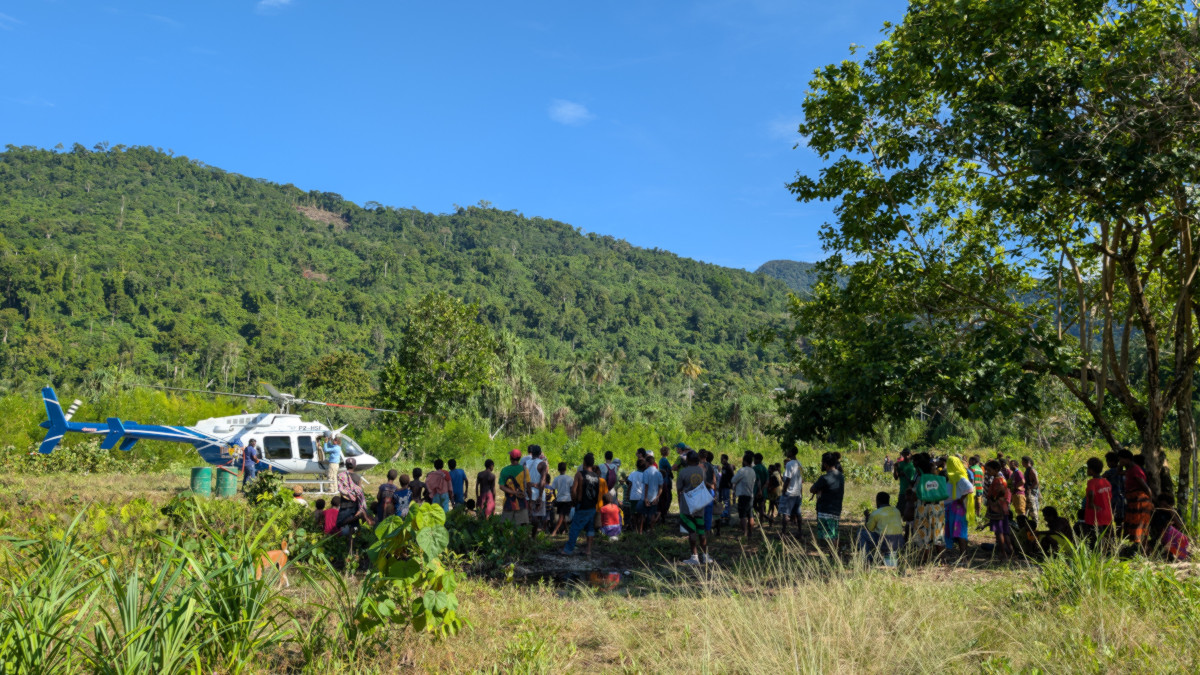
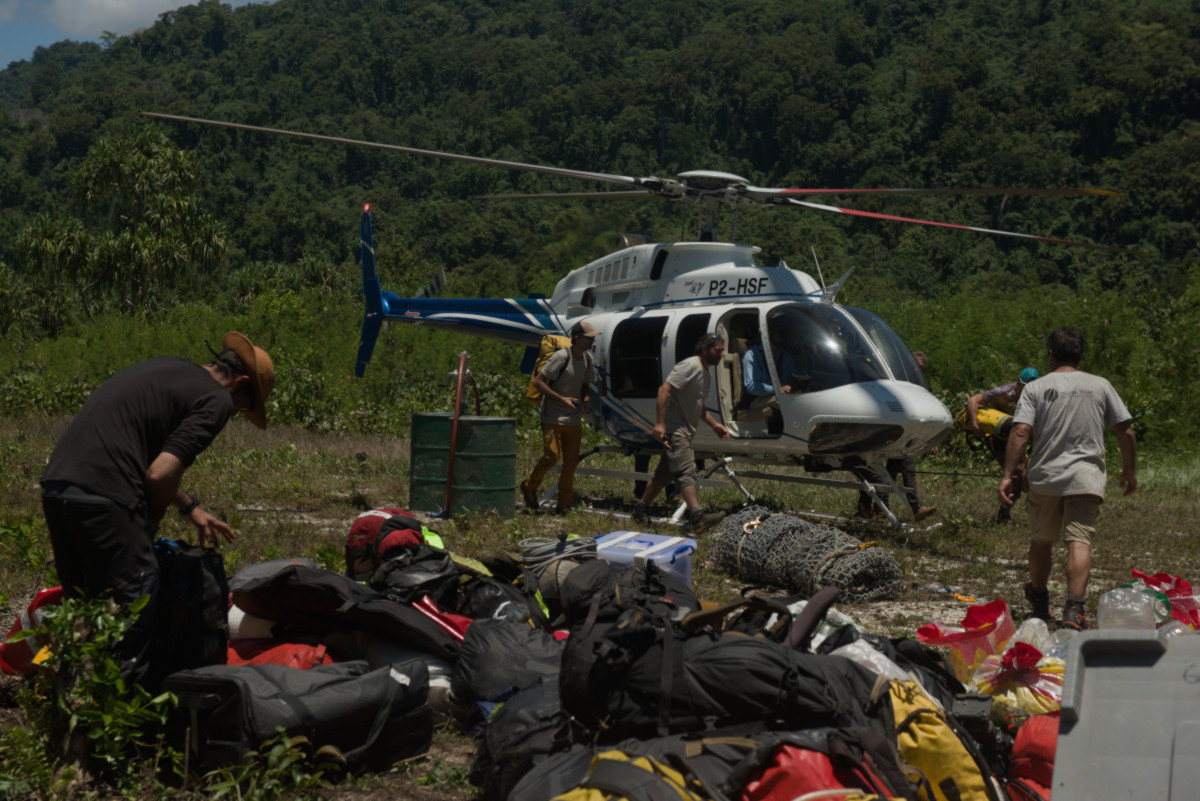
In a few days, the helicopter rotations will descend crew and equipment at Galowé, on the edge of the Pacific...


Publication précédente


Ultima Patagonia 2023

Madre de Dios

Expédition Ultima Patagonia 2023

Ultima Patagonia 2019

Madre de Dios

Expédition Ultima Patagonia 2019

Ultima Patagonia 2017

Madre de Dios

Expédition Ultima Patagonia 2017

Ultima Patagonia 2014

Diego de Almagro

Expédition Ultima Patagonia 2014

Ultima Patagonia 2010

Fourth expedition to Madre de Dios

Expédition Ultima Patagonia 2010

Ultima Patagonia 2008

Second Franco-Chilean expedition

Expédition Ultima Patagonia 2008

Ultima Patagonia 2006

First Franco-Chilean expedition

Expédition Ultima Patagonia 2006

Bornéo 2002

Expedition into the caves of Kalimantan

Expédition Bornéo 2002

Mongolia 2001

Reconnaissance expedition

Expédition Mongolie 2001

Ultima Patagonia 2000

Great expedition to Madre de Dios

Expédition Ultima Patagonia 2000

Ultima Esperanza 1997

First expedition on Diego de Almagro

Expédition Ultima Esperanza 1997

Diego de Almagro 1995

First reconnaissance

Expédition Diego de Almagro 1995